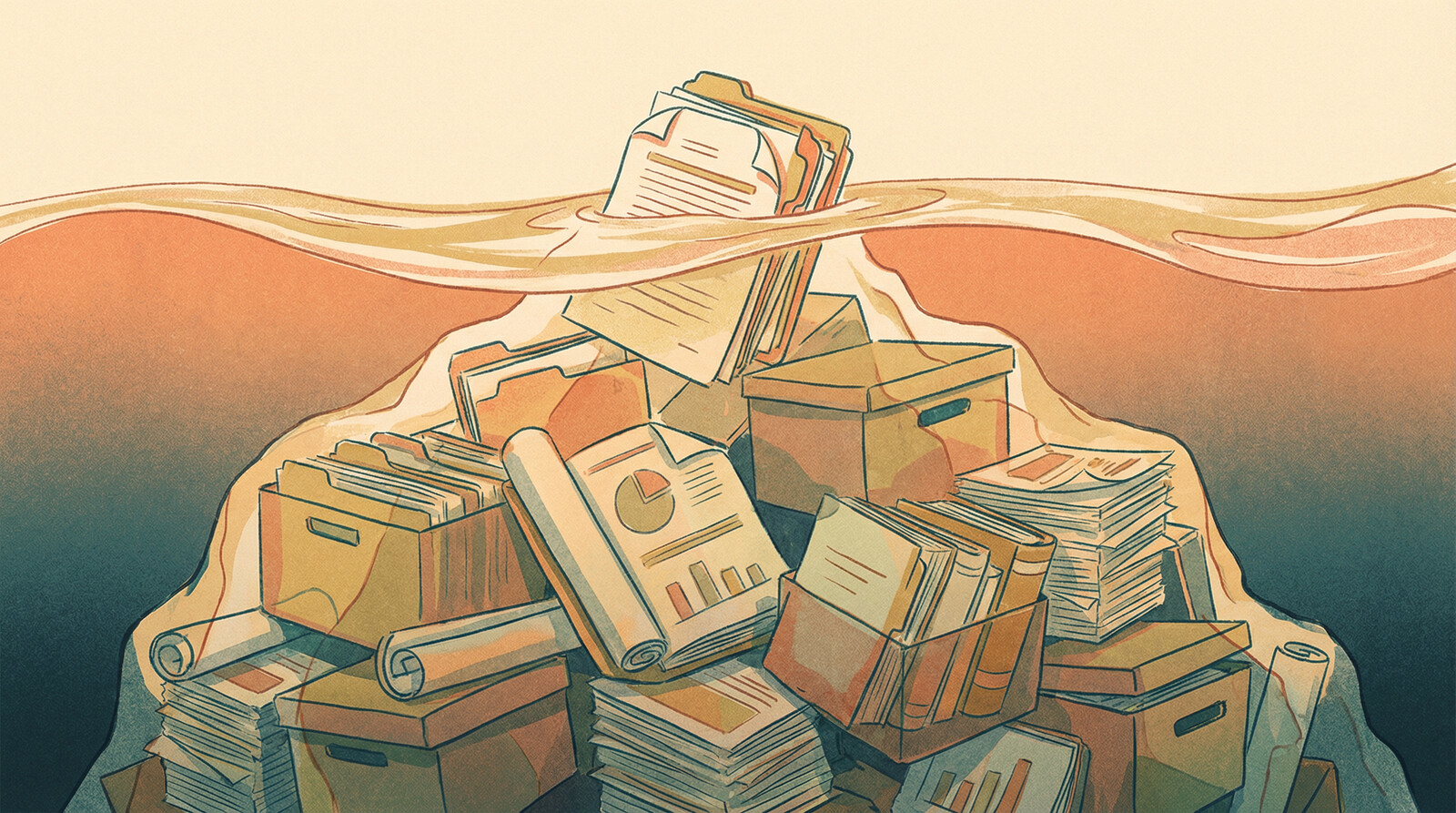
We're currently working with a client on a major EPA Superfund site. Their document collection includes over 50 reports spanning decades of environmental assessments, regulatory correspondence, and remediation records.
One of those documents is 7,000 pages.
Try dragging that into ChatGPT.
The Limits of "Just Upload It"
Consumer AI tools have made remarkable progress. ChatGPT, Claude, and others can now accept file uploads, and for many use cases—summarizing a contract, extracting key points from a report—they work surprisingly well.
But they have hard limits that become obvious when you're dealing with serious document work:
File size caps. ChatGPT limits uploads to 512MB per file, with a token cap of 2 million per document.1 That sounds generous until you realize a 7,000-page PDF with embedded images, tables, and figures can easily exceed those limits—and even if it doesn't, the system won't process it all at once.
Context window constraints. Consumer AI tools can only work with a fraction of a large document at once.2 When you upload a big file, the system doesn't load the whole thing. It builds an index and retrieves chunks on demand. You're never actually querying your full document—you're querying whatever the retrieval system decided to surface.
Text-only extraction. Most consumer AI tools can't process visual content in PDFs—charts, diagrams, tables rendered as images, engineering drawings.1 For environmental reports full of site maps, boring logs, and analytical tables, that's a significant blind spot.
No persistence across sessions. Upload a document today, and tomorrow it may be gone. Consumer tools are designed for one-off interactions, not ongoing work with document collections.
What "Processing" a Document Actually Means
When we say Statvis "processes" a document, we mean something very different from uploading a file to a chatbot.
Location awareness. We don't treat a PDF as a blob of text. Every piece of extracted content stays linked to its exact position—which document, which page, where on that page. When you cite a source, you point to a specific location, not just "somewhere in this 7,000-page file."
Structure preservation. Environmental reports aren't just prose. They contain tables, figures, headers, appendices, and complex formatting that carries meaning. We preserve the difference between a paragraph of text and a data table, between a heading and body content.
Comprehensive search. The result is a fully queryable representation of your document. Semantic search finds conceptually relevant content even when it doesn't contain your exact keywords. Keyword search catches exact matches. Both work together across the complete document—not just whatever chunks a retrieval algorithm decided to surface.
Why This Matters for a 7,000-Page Document
Let's make this concrete. That 7,000-page EPA document contains decades of site history: sampling results, regulatory correspondence, remediation activities, ownership transfers, permit modifications.
A user might ask: "What contaminants have been detected in groundwater at this site?"
With a consumer AI tool, you'd get results from whatever chunks the retrieval system surfaced—probably from the most recent or most "relevant-looking" sections. You'd have no way of knowing if critical detections from 1987 were missed because they didn't rank highly enough.
With proper document intelligence, you get comprehensive results spanning the full record, with every result linked to a specific page. The difference is stark: "here are some relevant excerpts" versus "here is everything in the record about this topic, with citations."
The Infrastructure Gap
There's a reason consumer AI tools don't do this: it's expensive and complex. It requires specialized infrastructure purpose-built for the problem.
Consumer tools are optimized for convenience and breadth—they need to handle everything from recipe questions to code debugging. Purpose-built document intelligence is optimized for depth—handling the specific challenges of working with large, complex document collections.
When "Good Enough" Isn't
For casual use, consumer AI is often good enough. If you need a quick summary of a report, ChatGPT will give you one.
But environmental consulting isn't casual use. When you're assessing liability for a Superfund site, "the AI probably found the important stuff" isn't an acceptable standard. You need comprehensive coverage. You need citations. You need to know that nothing was missed because it didn't rank highly enough in a retrieval algorithm.
That 7,000-page document is a Thursday for us. Our infrastructure exists because this is what real document work looks like—not uploading a 10-page PDF for a quick summary, but systematically processing decades of records to build a complete, queryable, citable knowledge base.
Consumer AI tools are remarkable for what they are. But they're not document intelligence infrastructure. And for work that actually matters, the difference is everything.
Yes, we used AI to help write this blog post. No, we didn't let it make up the citations. You can click every single one.
Footnotes
-
OpenAI Help Center. "File Uploads FAQ." 2025. ↩ ↩2
-
Anthropic Help Center. "Uploading Files to Claude." 2025. ↩