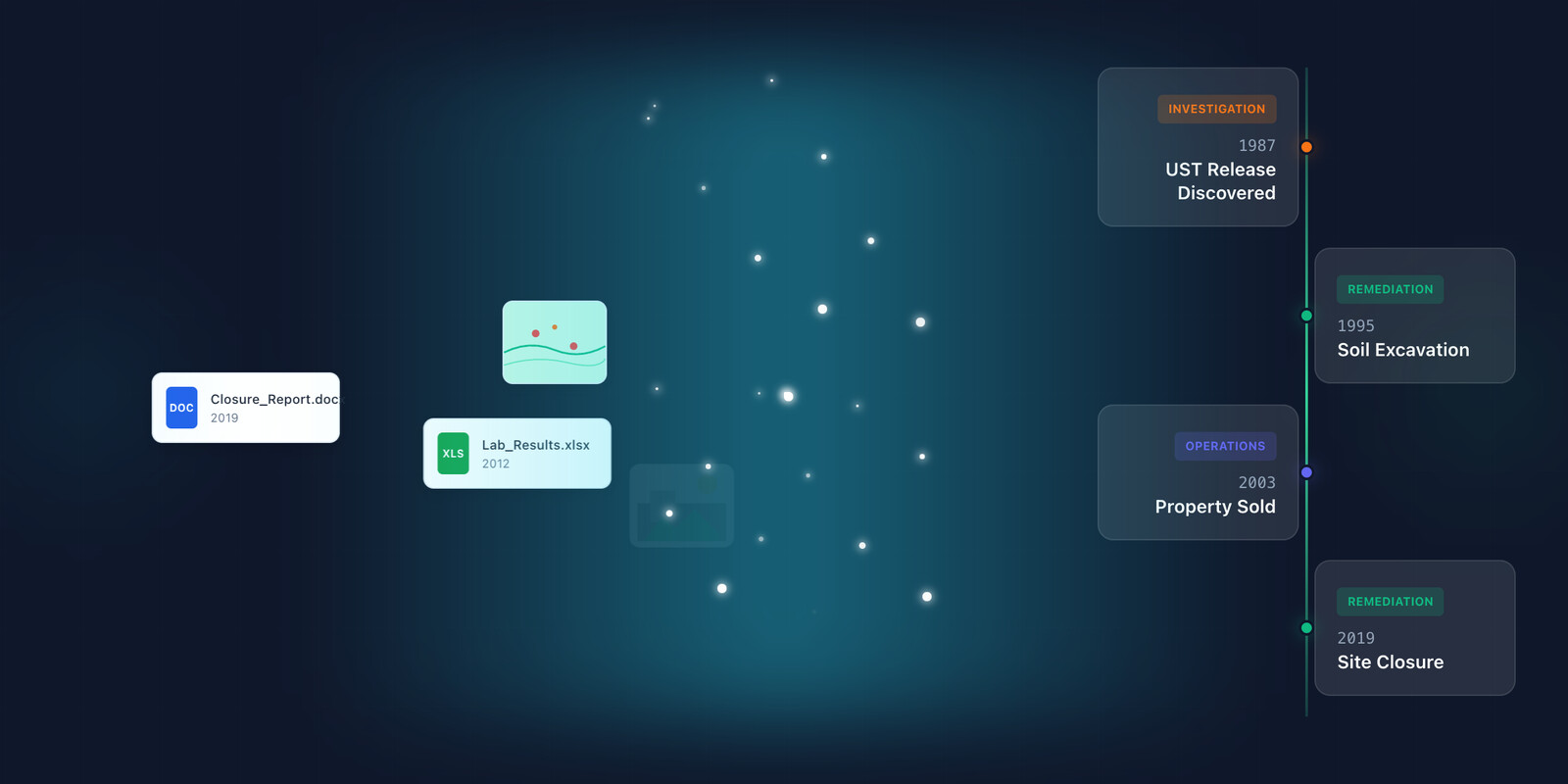
Investigating or litigating contaminated sites has always been a knowledge business. The value lies in knowing what data means, where it came from, and how it connects to everything else you've learned about a site over decades of investigation.
For years, we built Statvis around data. Sample results, chemical concentrations, guideline exceedances, spatial coordinates. The Explore module let teams visualize and analyze contamination patterns with precision that spreadsheets couldn't match. That foundation remains essential.
But data is only half the story.
The knowledge gap
Every contaminated site accumulates knowledge in two forms: structured data (lab results, monitoring wells, spatial boundaries) and unstructured knowledge (reports, correspondence, regulatory filings, historical assessments). The structured data fits neatly into databases. The unstructured knowledge—often spanning decades and thousands of pages—doesn't.
This is where institutional memory lives, and where it disappears.
When a senior scientist retires, when a project changes hands, when a site sits dormant for five years before reactivation—the data persists, but the knowledge disappears. Teams inherit filing cabinets and SharePoint folders without inheriting understanding.
We've watched this pattern repeat across hundreds of sites. The information exists. Finding it, connecting it, and trusting it is the problem.
Why now
Recent advances in language models have crossed a threshold that matters for our industry. Consumer-facing tools that generate plausible-sounding text have limited utility for work that demands accuracy and accountability. The meaningful advances are in retrieval, in structured extraction, and in grounding AI responses to verified source material.
These capabilities make it possible to build something we couldn't build three years ago: AI that understands your documents. AI that extracts structured events from narrative reports. AI that answers questions with citations you can verify.
We've invested deeply in this direction. Statvis is now an AI-first platform.
What AI-first means
Statvis converts your document archive into a queryable knowledge base. Decades of environmental documentation become searchable in plain English, with every answer citing the exact document, page, and passage it came from. Four principles guide how we've built it:
Every claim cites its source. When AI surfaces an insight, you can click through to the exact document, page, and passage it came from. This isn't a convenience feature. For work that may end up in court or in front of a regulator, traceability is non-negotiable.
Institutional memory persists. Site knowledge no longer disappears when staff leave or projects go dormant. The platform captures what your organization knows about a site and makes it queryable in plain English, regardless of who originally read those documents.
Natural language, environmental fluency. Generic language models don't recognize APECs, sampling locations, responsible parties, or regulatory references. Ours does. Industry-specific extraction means the system captures what actually matters for environmental work.
Professional judgment stays central. AI handles extraction and retrieval. You handle interpretation and decision-making. The platform augments expertise rather than attempting to replace it.
From data to knowledge
Data tells you that benzene concentrations exceeded Tier 1 guidelines in MW-12 during the 2019 sampling event.
Knowledge tells you that this exceedance likely originated from a 1987 fuel release documented in a Phase II report, that the responsible party was identified in 2003 litigation, that three remediation approaches were evaluated in 2015, and that the current monitoring program was established as part of a 2018 regulatory agreement.
Data lives in tables. Knowledge lives in documents, in context, in connections that span decades of site history.
Statvis now captures both.