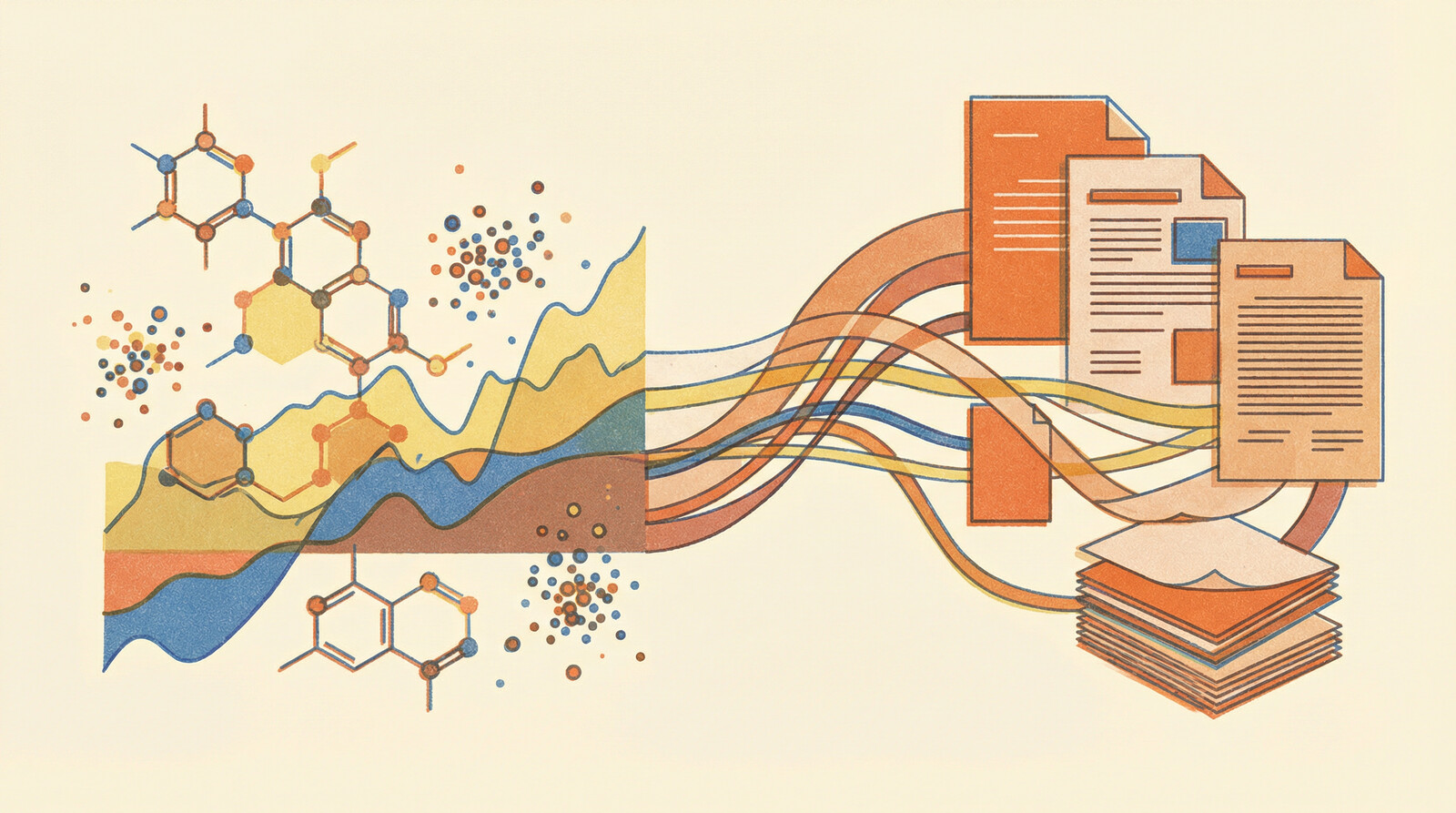
Statvis was founded on chemical fingerprinting and multivariate statistical analysis—the forensic tools consultants and lawyers use to get answers about sources of contamination from complex data. PAH fingerprinting to distinguish sources. PCB congener analysis to trace liability. Dioxin source identification for apportionment. Visualizations that turn forensic science into courtroom exhibits.
If you've worked with us, you know our DNA: precision, traceability, and workflows built for defensibility. We don't just make charts. We build tools that hold up under cross-examination.
Now we're applying that same forensic rigor to a different problem—one that's been quietly draining time and money from every investigation you've ever worked on.
The Problem Isn't Your Data. It's Your Documents.
You've got the analytical results figured out. You know how to read a lab report, interpret a guideline exceedance, and build a conceptual site model from boring logs and monitoring data.
But then someone asks: When did the underground storage tank get installed? Who was the responsible party in 1987? What did the consultant say about the off-site source in the Phase II addendum?
And suddenly you're opening fifty PDFs, scanning hundreds of pages, and hoping you didn't miss the one sentence buried in an appendix from fifteen years ago.
This isn't a data problem. It's a document problem. And it scales badly.
Large Collections, Lost Knowledge
Environmental sites generate mountains of paper. Decades of Phase I ESAs, Phase II investigations, remedial action plans, compliance reports, and correspondence. Every new consultant inherits the work of the last. Every transaction surfaces questions about site history that require digging through file cabinets or digital archives with inconsistent naming conventions.
The knowledge is there. But finding it—and knowing you found all of it—is a different story.
Traditional approaches don't scale:
- Manual review works for small projects but breaks down when you're looking at thousands of pages across multiple sites
- Keyword search finds words but misses context, synonyms, and the relationships between concepts
- Off-the-shelf AI tools like ChatGPT give plausible answers but don't cite sources, can't handle large collections, and have no concept of what matters in environmental litigation
The result? Hours spent re-reading documents you've already read. Institutional memory that walks out the door when consultants retire or change firms. And the nagging fear that you missed something critical because you didn't know where to look.
Traceability for Large Document Collections
Here's what we learned building forensic tools for chemical data: precision matters, but so does showing your work.
A PAH fingerprinting analysis doesn't just tell you there are multiple sources. It shows you which ratios support that conclusion, which samples cluster together, and why the data points to coal tar instead of petroleum. The visualization is the evidence.
We're taking the same approach to documents.
When Statvis answers a question from your site documents, you don't get a summary and a vague "according to the 2018 report." You get:
- The specific passage that supports the claim
- The document title, date, and page number
- A direct link to view the exact page in context
Every insight traces back to a source. Every source is verifiable. You can click through and see for yourself.
This isn't a nice-to-have feature. It's the difference between "the AI said so" and "here's the evidence."
Why This Matters for Institutional Memory
The environmental industry has a retention problem. Senior consultants retire. Project managers move firms. In-house counsel inherits litigation from predecessors who are no longer around to answer questions.
The institutional memory—the understanding of why decisions were made, what was investigated, and where the gaps are—walks out the door.
Documents are supposed to preserve that memory. But only if you can access them. Only if you can ask questions and get answers that point you to the right source at the right time.
Statvis doesn't replace professional judgment. It preserves and surfaces the knowledge embedded in decades of work so that judgment can be applied effectively.
The Same Forensic DNA, Applied to Documents
We haven't abandoned data analysis. Forensic fingerprinting, visualizations, and custom workflows are still core to what we do. But the problems we solve—apportionment, liability, regulatory defense, transaction due diligence—all depend on both data and documents.
The data tells you what's in the ground. The documents tell you how it got there, who knew about it, and what was done in response.
We built tools to make sense of the first. Now we're building tools to make sense of the second.
Same precision. Same traceability. Same focus on defensibility.
You've seen what we can do with data. Now you should see what we're doing with documents.
Ready to see document intelligence in action? Contact us to learn how Statvis handles large document collections, or request a demo to see traceability and citations at work.